WHOLESALE ONLY!
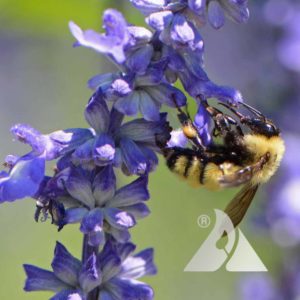
Oliger’s Bumblebee Buffet Mixture
Our newest mixture! The Bumblebee Buffet Mixture was designed for home garden use and is composed of flowers that are attractive to many species of bumble bees. This mixture is a blend of annual and perennial flowers that provide nectar and pollen to many species of bumblebees as well as other pollinators. It contains early, mid, and late blooming flowers in order to provide bumblebee forage all season long. Recommended for maintained plantings in home gardens and commercial landscapes.
This mix contains: Arroyo Lupine, Balsam ‘Camellia Flowered Mix’, Bergamot, Blue Sage, Dwarf Sulphur Cosmos, Gayfeather, Lacy Phacelia, Purple Coneflower, Purple Prairie Clover, Rocket Larkspur, Rocky Mountain Penstemon, Siberian Wallflower, Spurred Snapdragon, Yellow Lupine, Zinnia ‘Dahlia Flowered Mix’.
Planting rate: 9-18 lbs. per acre, 7 oz. per 1,000 sq. ft.
Planting times: best times to plant are spring, early summer, and fall.
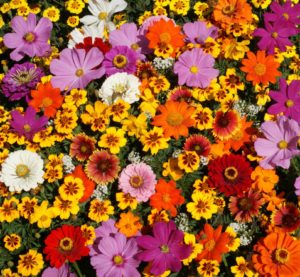
Oliger’s Monarch Butterfly Garden Mixture
(For home gardens, commercial landscaping and golf courses)
Monarch populations have been in decline for a number of years, and the loss of nectar sources and milkweeds has been indicated as a major contributor to these declines.
This mix is composed of nectar producing flowers for adult butterflies as well as milkweed which will provide egg-laying sites and food for monarch caterpillars.
This mix contains: Annual Candytuft, Butterfly Milkweed, Dwarf Cosmos, Gayfeather, Hoary Vervain, Indian Blanket, Marigold ‘Naughty Marietta’, Mexican Sunflower, Purple Coneflower, Rocket Larkspur, Siberian Wallflower, Smooth Aster, Sulphur Cosmos, Zinnia.
Planting rate: 12-24 lbs. per acre, 8 oz. per 1,000 sq. ft.
Seeds/lb. – 212,000
Planting times: best times to plant are spring, early summer, and fall.
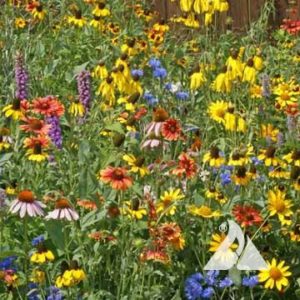
Oliger’s Midwest Mixture
Formulated for ILLINOIS, INDIANA, IOWA, eastern KANSAS, KENTUCKY, MICHIGAN, MINNESOTA, MISSOURI, eastern NEBRASKA, OHIO, WISCONSIN, Southern Manitoba and Ontario.
This mix contains: Black-Eyed Susan, Clasping Coneflower, Corn Poppy, Cornflower, Dwarf Evening Primrose, Grey-Headed Coneflower, Illinois Bundleflower, Indian Blanket, Lance-Leaved Coreopsis, Lavender Hyssop, Mexican Hat, New England Aster, Ox-Eye Sunflower, Plains Coreopsis, Prairie Coneflower, Purple Coneflower, Purple Prairie Clover, Scarlet Flax, Shasta Daisy.
Planting rate: 5-10 lbs./acre, 4 oz./1000 sq. ft.
Seeds/lb.: 593,000
Planting times: best times to plant are spring, early summer, and late fall
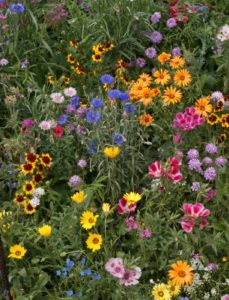
Oliger’s Knee Hi Mixture
This popular flower mixture is composed of annuals and perennials that are generally less than 24 inches tall at maturity. It is especially suitable for residential or commercial landscaping projects where height may be an issue.
This mix contains: African Daisy, Annual Baby’s Breath, Black-Eyed Susan, Blanketflower, Blue Flax, California Poppy, Candytuft, Chinese Forget-Me-Not, Corn Poppy, Dwarf Cornflower, Dwarf Godetia, Dwarf Plains Coreopsis, Dwarf Red Coneflower, Lance-Leaved Coreopsis, Moss Verbena, Rocket Larkspur, Scarlet Flax, Siberian Wallflower, Sweet Alyssum and Sweet William Pinks.
Planting rate: 8-16 lbs./acre, 5 oz./1000 sq. ft.
Seeds/lb.: 449,000
This mixture is less than 24 inches tall and provides a neater appearance than taller mixes. Good for residential or commercial landscaping where height is a factor.
Planting times: the best times to plant are spring, early summer or fall.
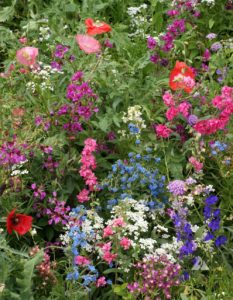
Oliger’s Sun & Shade Mixture
This colorful mixture is composed of annuals and perennials that tolerate partial shade. It works best in locations that receive strong, filtered sunlight or 1-4 hours of direct sun per day. This mix is not suitable for densely shaded locations.
Seeds/lb. : 449,000
Planting times: The best times to plant are spring, early summer or fall.
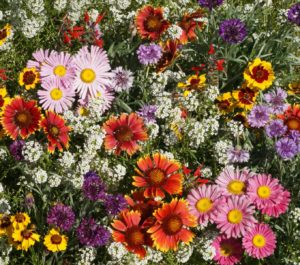
Oliger’s Bird & Butterfly Mixture
This annual and perennial mixture is great for creating a backyard habitat to attract your favorite winged wildlife. Flowers in this mix will provide colorful blooms all season long as well as nectar and seed for songbirds, hummingbirds and butterflies.
This mix contains: Black-Eyed Susan, Blanketflower, Butterfly Milkweed, California Poppy, Candytuft, China Aster, Dwarf Cornflower, Dwarf Godetia, Dwarf Plains Coreopsis, Gayfeather, Indian Blanket, Lance-Leaved Coreopsis, Lemon Mint, Mexican Hat, Perennial Lupine, Purple Coneflower, Rocket Larkspur, Scarlet Sage, Wallflower and Sweet Alyssum.
Planting rate: 11-22 lbs./acre, 8 oz./1000 sq. ft.
Seeds/lb.: 230,000
This choice mixture provides seeds and nectar to songbirds, hummingbirds, and butterflies.
Planting times: the best times to plant are spring, early summer and fall.
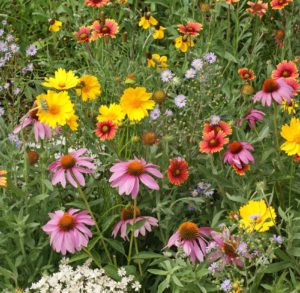
Oliger’s Honey Bee Mixture
This mix is a blend of annual and perennial flowers that provide nectar and pollen to honey bees. These flowers are proven favorites of honey bees in our gardens and will provide bee forage all season long. It is ideal for honey beekeepers and others interested in honey bee health. This mix can be used in garden beds, borders, and other maintained areas.
This choice mixture provides seeds and nectar to songbirds, hummingbirds, and butterflies.
Planting rate: 7 – 14 lbs./acre ; 5 oz./1,000 sq. ft.
Seeds/lb.: 442,000
Honey bees don’t just produce wax and honey, they are extremely valuable pollinators of many agricultural crops. Honey bees are not native to the U.S. and they originally came from Europe and were brought over by early colonists. The list of crops that are pollinated by honey bees is endless, including fruits, berries, nuts, clovers, alfalfa, canola, and many vegetables.
Planting times: the best times to plant are spring, early summer and fall.
Wildflower Planting and Cultural Information
Planting Instructions
When to Plant:
The best time to plant in your area depends on the climate and rainfall patterns as well as the species you are planting. In cool climates, plant annuals, perennials or mixtures of annuals and perennials in spring, early summer or late fall. Fall plantings should be late enough so that seeds do not germinate until spring. Perennials can also be sown in early fall provided that there are at least 10-12 weeks of growing time before the plants go dormant for the winter. In mild climates, plant during the cooler months of the year; fall through spring, for best results.
Site Preparation:
Before planting, remove all weeds and grasses; best results will be obtained by planting on cleared ground. Remove existing vegetation by pulling, tilling under, spraying with a general herbicide, or by a combination of these methods. Loosen compacted soil by scraping, tilling or scarifying. Tilling should be utilized only when soil is very compacted and further weed control measures can be taken.
Planting Rate:
A minimum and maximum planting rate is given for each mixture. A planting rate in the minimum range is usually sufficient to establish a good stand of wildflowers on prepared soil with adequate maintenance. The maximum rate is recommended when adequate soil preparation and weed control are impossible, or when a maximum display is required. Avoid using more than the recommended rates since poor perennial establishment may result.
Planting Depth:
If seeds are broadcast, rake in LIGHTLY, covering seeds no more than 2-3 times their thickness (some seeds will show on surface of soil). If seeds are drilled, drill to a maximum of 1/4 inch. If hydroseeding is the method of application, hydromulching will provide a top cover and conserve moisture.
Moisture:
Planted areas MUST be kept consistently moist for 4-6 weeks during the growing season until seedlings are well established. During this period, daily watering may be necessary if rainfall is inadequate. Thereafter, watering should be gradually reduced.
Wildflower Maintenance: Your Keys to Success
Maintenance is an essential ingredient in the creation of a successful wildflower planting. The key to an effective, long-term wildflower maintenance program is evaluation and timely follow-up. The site should be evaluated periodically during the growing season to determine if expectations are being met.
Reseeding:
Perennial plantings can be reseeded if there are bare spots in the area. It is best to reseed annuals every year if the long lasting color from annuals is desired. In the fall remove dead seed stalks and excessive plant material by mowing or cutting to a height of four to six inches. See “When to Plant” for reseeding in the fall. Spring reseeding should be completed as soon as the ground is workable.
Weed Control:
A monthly program of weed control is essential to ensure a satisfactory display of wildflowers year after year. Weeds should be eliminated as soon as they can be recognized, either by pulling, spot-spraying with a general herbicide, or selective cutting with a string trimmer.
Supplemental Watering:
Water is a critical factor in wildflower maintenance. In moist climates, regular rainfall may make supplemental watering unnecessary. In arid climates or during drought conditions, up to 1/2 inch of supplemental water per week may be required to maintain an optimal display.
Fertilization:
Fertilizers are usually not necessary for wildflower plantings. However, if soil fertility is very low, a low nitrogen fertilizer can be used, or add organic matter such as compost. If you suspect a problem with soil fertility, we recommend a soil test and/or plant tissue analysis.
Fall Mowing and Cleanup:
If a neat appearance is desired after the wildflowers have gone to seed, mow them to a height of four to six inches.